Charlie's Story The Law The Threat Take Action Donate
Seen the billboard?  You're in the right place.
⚠  Charlie's Law Is Under Threat — Contact Your Legislator Today
Louisiana Act 409 — Charlie's Law

More Than 1 Child Is Sexually Assaulted
At School Every Day in Louisiana.

76 victims were ages 3–5.
This is happening right now — and it is preventable.

224 children. One school year.

224
Reported Assaults
This Year
76
Victims Ages 3–5
1+
Per School Day
Assaulted

Reported since August 1st — not even a full school year. Many more go unreported.

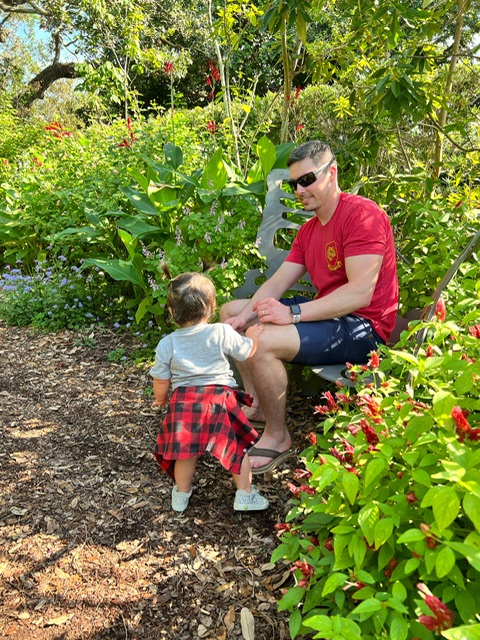
Charlie and her dad

This is happening in Louisiana schools right now.

My name is MAJ Roger Williams. I'm a Combat Veteran, husband — but most importantly, I'm Charlie's dad.

Two years ago, our 3-year-old daughter Charlie was sexually assaulted at a private school by another child.

What happened next was just as devastating — the system failed her completely.

Child Protective Services could not act — the incident did not occur in the home or involve a caregiver, placing it outside their jurisdiction
Law enforcement declined to pursue the case — the child responsible was below the age of culpability under Louisiana law
The Department of Education had no authority — a decades-old loophole meant Pre-K 3 and 4-year-old programs were not required to be licensed or regulated

At the time, 254 early childhood programs in Louisiana operated without any licensing requirements. There was no accountability. No oversight. No protection.

"The weeks that followed, my mental health would be equivalent to, if not worse than, my combat deployment to Iraq."

Instead of walking away, we went to the Legislature and told Charlie's story. ACT 409 — Charlie's Law — passed unanimously in both the Louisiana House and Senate. Not a single member voted no.

Senator Regina Barrow said: "We need to get this gap closed. There is no reason this school shouldn't be treated like any other school." Senator Jay Luneau: "We've failed this child, and we need to fix this problem."
Watch Our Senate Testimony
Jana and I testified before the Louisiana Senate — 2:27–3:08  ·  Senate Committee, January 2025
What We Passed

What Is Charlie's Law? (ACT 409)

ACT 409 of the 2025 Louisiana Regular Session — "Charlie's Law" — was signed into law on June 20, 2025. Both the Louisiana House and Senate passed it unanimously — not a single member voted no. For the first time, all early learning centers including private and religious programs must be licensed by the Louisiana Department of Education. And every school must follow the 15 universal child safety standards — no exceptions. Here's what it does:

📋

Licensing for Private Programs

Private and religious pre-K programs serving children ages 3 and older are now required to be licensed by the Louisiana Department of Education — closing the gap that left Charlie unprotected. Public schools operate under separate existing oversight.

🛡️

15 Safety Standards for ALL Schools

Every school in Louisiana — public and private — must follow the 15 minimum child safety and welfare standards, including background checks for staff, mandatory reporting requirements, and basic protections for children in their care.

📢

Reporting Requirements

Charlie's Law clarifies and strengthens reporting obligations for child-on-child sexual abuse incidents in school settings, ensuring incidents can no longer be quietly swept under the rug.

👁️

Supervision & Bathroom Safety

Children must be supervised at all times — including during restroom use and outdoor activities. Facilities must post safety standards visibly and staff must always know exactly who they are responsible for.

👶

Child-to-Staff Ratios

Charlie's Law defines maximum supervision ratios by age — ensuring no child is left without a responsible adult. These ratios are not new. They were already established in Louisiana Bulletin 137 (Louisiana Administrative Code). Charlie's Law put them into statute, making them enforceable as law for the first time.

Age Group Max Children per Staff Member
Infants (under 1 year) 5 : 1
1 year old 7 : 1
2 years old 10 : 1
3 years old (Charlie's age) 13 : 1
4 years old 15 : 1
5 years old 19 : 1

Source: Louisiana Bulletin 137 (Administrative Code) — codified into statute by ACT 409 (Charlie's Law), 2025.

📋

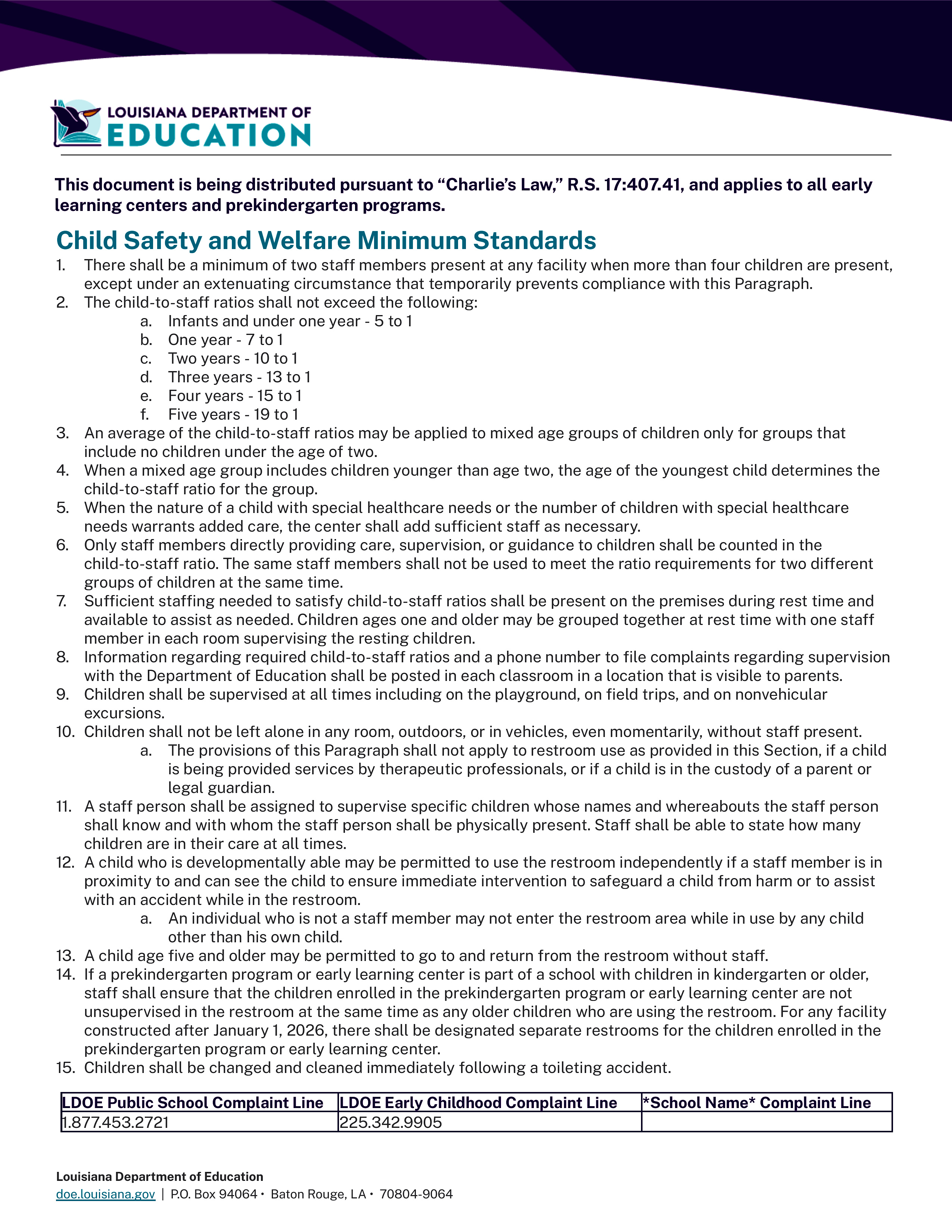
ACT 409 — Child Safety & Welfare Standards

The 15 universal child safety standards that every school in Louisiana must now follow — no exceptions, no exemptions.

ACT 409 Child Safety and Welfare Standards — the 15 universal standards every Louisiana school must follow
🔔

Mandatory Parent Notification

All suspected or confirmed abuse must be reported — and schools must notify parents directly, regardless of who the perpetrator is. Families can no longer be left in the dark. Parents receive the safety standards document every school year.

What's Happening Now

Today, Those Protections
Are Being Challenged.

Some are pushing to weaken accountability and oversight. We believe children deserve stronger protections — not weaker ones.

Even after hundreds of millions of dollars in legal settlements tied to failures in child safety, schools continued to operate. The system has proven it can withstand accountability.

The question is simple: Do we protect systems — or protect children?

We have deep respect for the legislators who fought alongside us to pass Charlie's Law — including those whose names are now attached to Senate Bill 441. We understand that no law is perfect, and we are open to improvements. What we are not open to is any version of this bill that trades real accountability for the appearance of it. Call the system whatever you want. Just make it work for the children.

Currently Under Review  ·  SB 441  ·  2026 Regular Session

What We're Asking For

If the system changes, these principles must carry through — for every child, in every program.

Clear Enforcement Mechanisms

Removing licensure is only acceptable if there is a defined, independent system to verify compliance — not self-attestation, not paperwork filed once a year. Real enforcement means unannounced visits, documented findings, and a transparent public record. SB 441 adds annual monitoring, which is a step — but the consequences for violations must be swift and certain, not discretionary.

Immediate Consequences for Violations

A written warning is not enough when a 3-year-old's safety is at stake. Any program that violates child safety standards must face immediate, mandatory consequences — not a corrective action plan that gives them time to correct what they should never have done. The current bill language allows too much discretion when a child's welfare is on the line.

Supervision Standards That Reflect Reality

Supervision ratios must reflect what children actually need — not what is operationally convenient. Raising the ratio for 4-year-olds from 15 to 20 children per adult — even temporarily — moves in the wrong direction. Charlie was 3.5 years old. These are not numbers on a spreadsheet. They are children in a room with one adult.

No Blanket Exemptions

Any program — regardless of whether it is called a school, a camp, a ministry, or a daycare — that places children in the care of adults must meet basic safety standards. Expanding the "camp" exemption to include 3-year-olds in religious programs creates the same gap Charlie fell through. The name on the door does not change the responsibility to protect what's inside.

"We are not here to make anyone's life harder. We are here because a system failed our daughter — and 224 children after her. We are willing to work with anyone who is willing to put children first. That is the only ask."

— Charlie's Dad & Mom

We are not anti-faith. We are not anti-private schools. We are pro-child.
History will repeat itself if we don't keep strong accountability at the center of whatever comes next.

Contact Your Legislator Read SB 441 →
Direct From Their Website

In Their Own Words

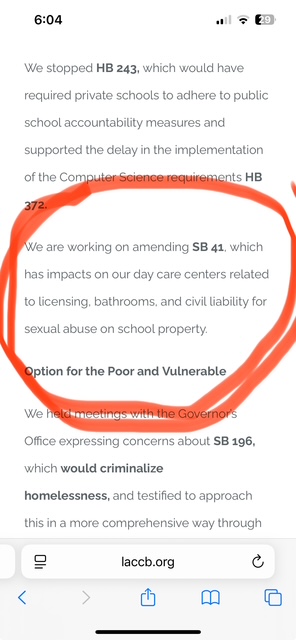
While Charlie's Law (then SB 41) was still being debated, the Louisiana Conference of Catholic Bishops published this legislative update on their own website — laccb.org. No interpretation needed.

Screenshot — laccb.org Legislative Update
Louisiana Conference of Catholic Bishops legislative update showing opposition to Charlie's Law
📸
Save screenshot as bishops-statement.jpg
in your website folder
The Circled Passage
"We are working on amending SB 41, which has impacts on our day care centers related to licensing, bathrooms, and civil liability for sexual abuse on school property."
— Louisiana Conference of Catholic Bishops, Legislative Update  ·  laccb.org
SB 41 = Charlie's Law
SB 41 is the bill that became ACT 409 — Charlie's Law. The Bishops were working to amend it before it ever passed.
Civil Liability for Sexual Abuse
Limiting civil liability for sexual abuse on school property means making it harder for families to hold institutions legally accountable when a child is assaulted.
Licensing & Oversight
Opposing licensing means opposing the background checks, inspections, and accountability measures that protect 3- and 4-year-olds in their care.

This is not about faith. This is not about religion. Every child — regardless of where they attend school — deserves the same basic protections. No institution should be exempt from accountability when the safety of a 3-year-old is at stake.

What You Can Do

What Happens Next Matters

Three things you can do right now to protect Louisiana's children.

1

Contact Your Legislator

Louisiana lawmakers need to hear from you. Tell them you support Charlie's Law and oppose any effort to weaken its child safety protections. It takes less than 5 minutes.

Find My Legislator →
2

Share This Message

Every share puts more eyes on this issue. Post on social media, text the link to friends and family, and make sure people in your community know what's at stake.

3

Read & Share ACT 409

Read the actual text of Charlie's Law so you know exactly what's at stake. Share the official Louisiana DOE page so others can see what the opposition wants to take away.

Official DOE Page Read the Full Law

Spread the Word

Use these buttons to share CharliesLawNow.org on social media.

Setting the Record Straight

What You May Be Hearing —
And the Facts

There is a lot being said about Charlie's Law.

Here are the facts.

What Some Are Saying

"Child sexual assault in school settings isn't a widespread problem in Louisiana."

The Facts

224 cases of child-on-child sexual assault in school settings have been reported in Louisiana — since August 1st alone. Not even a full school year.

76 of those victims were between the ages of 3 and 5 — the exact age group Charlie's Law was designed to protect.

These are only the reported cases. Incidents involving young children are historically underreported.

More than one child is being assaulted at school every single school day in Louisiana. This is not a rare event. It is a pattern.

What Some Are Saying

"Charlie's Law is regulatory overreach — it goes far beyond its original purpose."

The Facts

Charlie's Law was written in direct response to a specific, documented failure: a 3-year-old was sexually assaulted at an unlicensed private early learning center, and both law enforcement and child services declined to act.

The law closes a gap that had existed in Louisiana for decades — programs serving the youngest children operated with no state licensure, no inspections, and no enforceable safety standards.

Both the Louisiana House and Senate passed it unanimously — not a single member voted no.

Charlie's Law does exactly what it was designed to do: ensure that every child in every program has the same basic protections.

What Some Are Saying

"Charlie's Law affects summer camps."

This claim has been used to suggest the law is overly broad or disruptive to community programs.

The Facts

Charlie's Law applies specifically to school-based early childhood programs serving children under five. It does not apply to summer camps.

Summer camps are governed under a separate legal framework — Louisiana Revised Statutes §17:407.33 and §17:407.35, enacted by Act 868 of 2014 — which defines camps and places them outside the licensing requirements for early learning centers.

Claims that Charlie's Law affects summer camps are incorrect. This distinction is clear in Louisiana law.

What the Current Law Actually Allows

Under current Louisiana law, summer camps — including those serving young children — operate outside the licensing framework that applies to early learning centers. This means:

  • Camp staff are not required to undergo background checks under this framework.
  • There are no state-mandated supervision standards specific to camps serving young children.
  • There are no enforceable reporting requirements for suspected abuse in camp settings equivalent to those in licensed programs.
What SB 441 Proposes to Change

Rather than address these gaps, SB 441 proposes to lower the camp age exemption from 5 years old down to 3 years old — and extends that exemption specifically to religious organizations running camps, Bible schools, and religious programs for children of any age.

Since August, there have been over 200 reported child-on-child sexual assaults in school settings — environments with structured systems and trained staff.

The question is reasonable: if these incidents occur in settings with staff requirements and oversight, what protections exist for 3-year-olds in environments with none?

What Some Are Saying

"This interferes with church activities or prevents children from interacting across age groups."

The Facts

Charlie's Law does not prohibit normal school or church activities.

It requires appropriate supervision and safeguards — especially in vulnerable environments such as restrooms or unsupervised areas.

The goal is not to separate children unnecessarily. The goal is to ensure they are safe.

What Some Are Saying

"This will shut down schools or reduce access."

The Facts

Schools across Louisiana have continued operating even after significant legal settlements related to failures in child safety.

Basic safety standards — supervision, reporting, accountability — already exist in many environments that care for children.

The question is not whether schools can operate under these standards. It is whether children should be protected by them.

What Some Are Saying

"This affects curriculum or religious instruction."

The Facts

Charlie's Law does not regulate curriculum, religious instruction, or how schools teach.

It focuses strictly on health, safety, supervision, and reporting standards for young children.

What Some Are Saying

"This impacts carpool or normal daily operations."

The Facts

The law does not regulate carpool, drop-off, or routine daily logistics.

It ensures that when children are in the care of a school, there are clear expectations for supervision and accountability.

What Some Are Saying

"Schools are already safe because they are accredited."

The Facts

Accreditation and licensure serve two very different purposes.

Accreditation is typically conducted by private organizations and focuses on whether a school has policies, procedures, and educational standards in place. These reviews often occur periodically — sometimes every few years — and are designed to evaluate overall quality and structure.

Licensure is a state requirement focused on health, safety, supervision, and accountability. It establishes clear, enforceable standards for how children are protected on a day-to-day basis.

Accreditation may confirm that policies exist.

Licensure and oversight help ensure those policies are actually followed — and that they work.

Both can play a role, but they are not interchangeable.

When it comes to protecting young children, having policies on paper is not enough.

There must be consistent oversight to ensure policies are being followed and schools are held accountable.

The Real Question

Some organizations have raised concerns about accountability, licensing, and oversight.

These concerns highlight the core issue:

Should basic safety protections apply to every child — or not?

For the Media

This Effort Is Led by Parents — Not Special Interests

We are advocating for common-sense protections, transparency, and accountability. Our position is based on documented facts, public legislation, and firsthand experience with a system that failed our daughter.

"This law is about one thing — making sure no child falls through the same gaps our daughter did."

— MAJ Roger Williams, Charlie's Dad  ·  CharliesLawNow.org

For media inquiries, interviews, or additional information, please contact us directly.

Media Inquiries →